
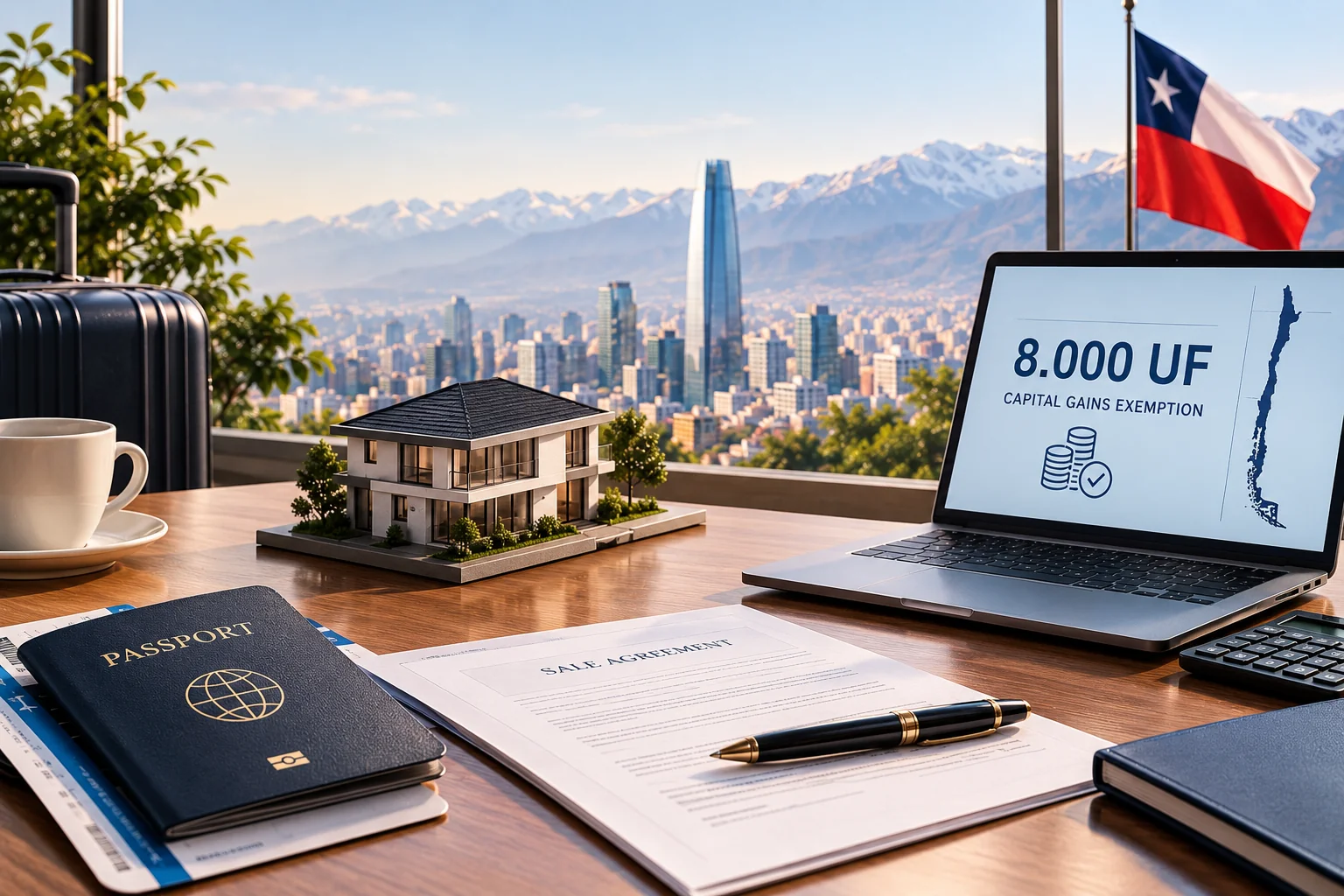
Owning real estate in Chile can be a valuable investment for foreign residents and international families. However, when the time comes to sell, many owners face an important concern: how much Chilean tax will they have to pay on the profit, and can they transfer the proceeds abroad without unexpected tax costs?
The concern is understandable. A property purchased years ago may have increased considerably in value. For a non-resident owner, an incorrectly structured sale or an incomplete understanding of Chilean tax rules can lead to unnecessary tax exposure, delays and complications when transferring the proceeds internationally.
One of the most relevant provisions is the 8,000 UF capital gains benefit under Article 17 No. 8 of Chile’s Income Tax Law (Ley sobre Impuesto a la Renta).
However, this benefit is not an automatic exemption for every foreign property owner. Eligibility depends on the seller’s legal and tax status, the property’s acquisition history and the conditions of the transaction.
What is the 8,000 UF capital gains benefit?
Chile’s tax legislation allows qualifying individuals to treat up to 8,000 UF in accumulated capital gains from the sale of Chilean real estate as non-taxable income (ingreso no constitutivo de renta).
In practical terms, this means that an eligible individual may sell one or more properties and use this lifetime allowance against the capital gains generated by those transactions.
The 8,000 UF limit is:
- A lifetime allowance, not an annual exemption.
- Shared across qualifying property sales, regardless of the number of properties sold.
- Applied to the capital gain, not to the property’s total sale price.
- Reduced by any portion of the allowance already used in previous transactions.
For example, if an eligible individual generates a capital gain of 5,000 UF and has not previously used the benefit, that gain may fall entirely within the available allowance, provided all legal requirements are satisfied.
The remaining allowance would then be 3,000 UF for future qualifying sales.
Can non-residents and foreign property owners qualify?
Yes. This is an important point for international investors.
The Chilean Internal Revenue Service (SII), in Official Ruling No. 528 of March 19, 2018, expressly clarified that the regime under Article 17 No. 8 may apply to natural persons whether or not they are domiciled or resident in Chile.
Therefore, living abroad does not automatically disqualify an individual from the 8,000 UF benefit.
Nevertheless, several conditions must be reviewed:
- Individual ownership: The seller must be a natural person. Companies generally cannot use this particular benefit.
- Tax treatment: The seller must not be subject to First Category Tax (Impuesto de Primera Categoría) on the basis of effective accounting records for the relevant activity.
- Unrelated buyer: The sale must not be made to a related party under the statutory rules.
- Minimum holding period: Generally, more than one year must have elapsed between acquisition and sale. Special four-year requirements apply to certain subdivided land transactions and sales of buildings by floors or apartments.
- Acquisition date: The applicable transitional rules must be reviewed, particularly for properties acquired before January 1, 2004.
These requirements must be assessed together. Being a foreign resident is not, by itself, either a qualification or a disqualification.
What happens if the capital gain exceeds 8,000 UF?
The benefit does not necessarily eliminate tax on the entire profit.
If the qualifying capital gain exceeds the remaining 8,000 UF allowance, the excess may be subject to Chilean income tax.
For individuals without domicile or residence in Chile, the relevant tax is generally Additional Tax (Impuesto Adicional).
Unlike Chilean residents, non-resident individuals do not have access to the 10% substitute tax option available under the relevant rules to qualifying residents.
The tax treatment also depends on whether the gain is received or merely accrued. For non-residents, the applicable regime generally taxes the gain on a received basis.
This makes it particularly important to review the payment structure, transaction documents and any withholding obligations before signing the sale agreement.
What if the property was inherited?
Foreign heirs who inherit real estate in Chile should pay particular attention to the property’s tax history.
The tax treatment of a later sale may depend on the applicable tax basis, the inheritance valuation rules and the inheritance tax paid.
Chile’s Income Tax Law also contemplates a credit for inheritance tax paid in connection with the inherited property, subject to the applicable statutory requirements and limitations.
Consequently, heirs should not assume that the property’s current market value is automatically its tax cost, or that the entire difference between the sale price and the fiscal valuation will necessarily be taxable.
A review of the inheritance documents, tax declarations and acquisition history is essential before calculating the capital gain.
Can you transfer the sale proceeds outside Chile?
Selling a property and transferring the proceeds abroad are two related but separate matters.
The 8,000 UF benefit concerns the income tax treatment of the capital gain. It does not automatically exempt every aspect of the international transfer of the sale proceeds.
Banks and financial institutions may require supporting documentation to verify the origin of the funds and the legitimacy of the transaction.
Depending on the circumstances, this may include:
- The property sale deed.
- Evidence of the original acquisition or inheritance.
- Tax declarations and payment certificates, where applicable.
- Documentation supporting the calculation of the capital gain.
- Banking information and evidence of the funds’ origin.
A properly documented transaction can make the international transfer process more straightforward and reduce the risk of unnecessary delays.
Why should you review the transaction before selling?
For non-resident owners, the most important tax decisions should be made before the property is sold, not after the proceeds have been received.
A preliminary legal and tax assessment should establish:
- The property’s acquisition date and tax basis.
- The seller’s tax status and eligibility for the 8,000 UF benefit.
- Whether the buyer is considered a related party.
- The amount of the lifetime allowance already used.
- The estimated capital gain and potential Additional Tax exposure.
- Any withholding, reporting or documentation requirements.
- The appropriate procedure for transferring the proceeds abroad.
This review is particularly important when the property was inherited, acquired through a donation, held jointly or transferred through a corporate structure.
Repatriate your real estate gains with the right tax strategy
Selling a property in Chile while living abroad does not necessarily mean paying tax on the entire capital gain.
The 8,000 UF benefit can provide significant tax relief for eligible individuals, including certain non-resident sellers. However, the result depends on the property’s history, the seller’s circumstances and compliance with Chilean tax legislation.
Repatriate your real estate gains safely. Calculate your tax-free capital gain allowance with our tax attorneys.
Becker Abogados advises foreign property owners, investors and non-resident heirs on Chilean real estate taxation, capital gains planning and cross-border asset transfers.



Recent Comments