
Chile offers international investors an attractive residential real estate market, but the return on a rental property depends on more than its purchase price and monthly rent. Income taxes and property taxes can significantly affect net yields.
One regime worth understanding is DFL2, a special legal framework designed to encourage the development and ownership of economical residential housing.
For qualifying properties, DFL2 can provide meaningful tax advantages. However, these benefits are subject to strict requirements, and not every foreign buyer or investment structure qualifies.
What is DFL2 in Chile?
Decree with Force of Law No. 2 of 1959 (DFL2) establishes a special regime for qualifying residential properties.
Generally, a property must:
- Be intended for residential use.
- Have a built area of no more than 140 square meters per housing unit.
- Comply with the applicable construction and legal requirements.
- Be formally recognized as a DFL2 property in the relevant documentation.
A buyer should verify the property’s DFL2 status before completing the purchase. Its size or residential use alone does not guarantee eligibility.
Rental income tax exemption: a significant advantage
One of the most attractive DFL2 property tax benefits in Chile is the treatment of rental income.
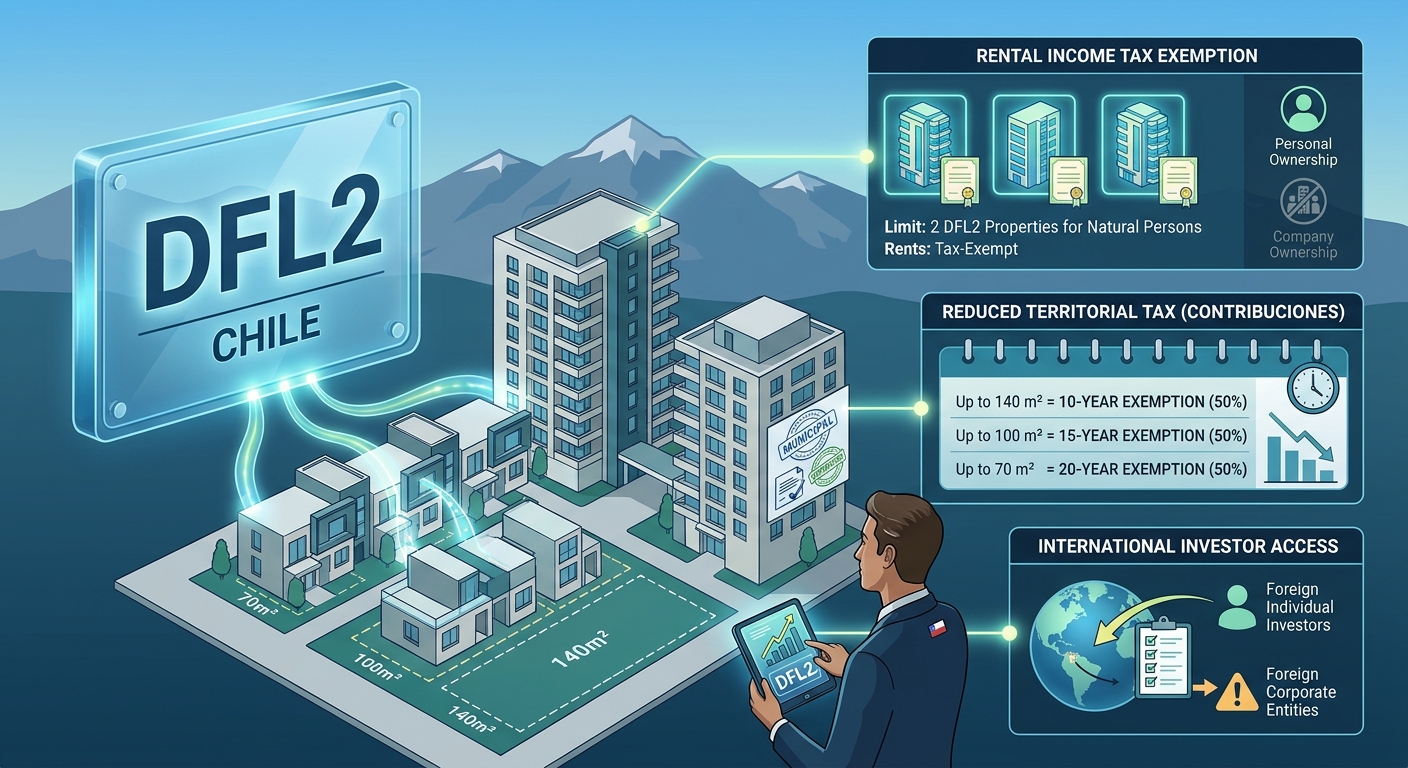
Under the current rules, natural persons may receive rental income free from income tax for up to two qualifying DFL2 residential properties. The benefit applies to the two properties with the earliest acquisition dates.
This restriction is particularly important for international buyers:
- A foreign individual investing personally may qualify, provided the legal requirements are met.
- The exemption is limited to two qualifying residential properties.
- From the third property onward, rental income must be assessed under the applicable tax rules.
- Companies and other legal entities cannot use this particular rental-income exemption.
The distinction between buying personally and investing through a company can therefore have a direct impact on the after-tax return.
Reduced property tax through territorial tax exemptions
DFL2 also provides a benefit involving Chile’s Impuesto Territorial, commonly known as contribuciones.
Qualifying residential properties receive a 50% exemption for a limited period, determined by their built surface area:
| Built area per unit | Exemption period |
| Up to 70 m² | 20 years |
| Over 70 m² and up to 100 m² | 15 years |
| Over 100 m² and up to 140 m² | 10 years |
The exemption is calculated from the date of the relevant municipal reception certificate. It does not eliminate every property-related charge: the statutory treatment excludes the municipal portion of the territorial tax, and the land itself does not automatically receive the same exemption.
For an investor evaluating residential real estate investment in Santiago, this benefit can improve operating costs during the applicable period.
Can foreign investors access DFL2 benefits?
Foreign nationality does not automatically disqualify an individual from DFL2 benefits. However, the investor’s legal and tax position must be reviewed.
A foreign individual without domicile or residence in Chile may be subject to Additional Tax on Chilean-source rental income under the general rules. The SII recognizes that qualifying DFL2 rental income can fall within the applicable exemption, subject to the statutory restrictions.
The practical distinction is crucial: the investor must qualify as an individual owner and meet the conditions of the DFL2 regime. Purchasing through a Chilean or foreign company does not produce the same result.
Investors should also consider their country of tax residence. A Chilean exemption does not necessarily mean the rental income will be exempt in the investor’s home jurisdiction.
What should investors verify before buying?
Before purchasing a property advertised as DFL2, an investor should review:
- Legal status: confirm that the property is formally covered by DFL2.
- Built surface area: verify the approved area and any subsequent extensions.
- Ownership structure: determine whether personal ownership or a company is more appropriate.
- Property history: establish whether the investor already owns other DFL2 properties and which two qualify for the rental exemption.
- Territorial tax: check the remaining period and actual amount of the property tax exemption.
- Cross-border taxation: review how the rental income will be treated in Chile and in the investor’s country of residence.
A property marketed as DFL2 should never be treated as automatically tax-exempt without reviewing its records and the buyer’s circumstances.
Make the tax structure part of your investment strategy
DFL2 can make Chilean residential real estate more attractive, particularly for individual investors seeking rental income and lower ownership costs. But the benefits depend on the property’s legal status, the number of qualifying properties held and the investor’s ownership structure.
The right decision should be made before signing the purchase documents, not after the first rental income is received.
Maximize your rental yields. Learn how DFL2 properties can optimize your annual tax footprint in Chile.
Becker Abogados can help international buyers review DFL2 eligibility, compare personal and corporate ownership structures, and assess the Chilean tax implications of a residential property investment.


Recent Comments