
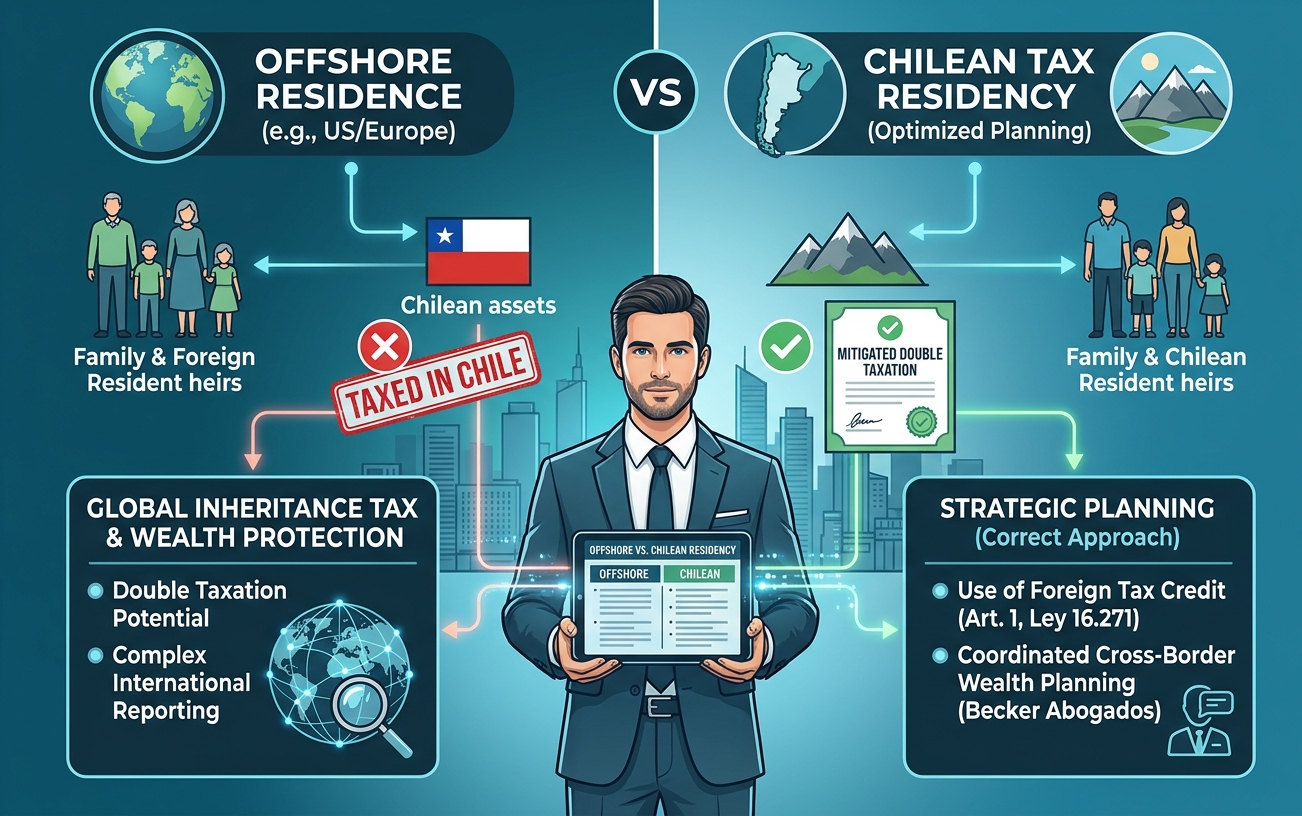
For international families, inheriting assets across borders can create an unexpected tax and administrative burden. A parent may own real estate, company shares or investments in Chile, while their children live in the United States, Spain, the United Kingdom or another country.
When the inheritance takes place, the family may face tax obligations in more than one jurisdiction, different reporting requirements and separate succession procedures.
The central question is not simply where the heirs live. It is where the deceased was domiciled, where the assets are located and how those assets were acquired.
Understanding these factors before transferring wealth can help families avoid unnecessary costs and complications.
Does Chile tax inheritances received by foreign residents?
Yes. A beneficiary does not automatically escape Chilean inheritance tax because they live abroad.
Under Law No. 16,271, Chilean inheritance tax applies to assets included in the taxable estate according to the deceased’s circumstances and the origin and location of the assets.
The general framework distinguishes between two situations:
- Deceased domiciled in Chile: assets located in Chile and abroad must generally be included in the inheritance inventory.
- Foreign deceased: assets located abroad must generally be included only when they were acquired with resources originating in Chile. Assets located in Chile remain relevant for Chilean inheritance tax.
Consequently, a foreign-resident heir receiving a Chilean property or shares in a Chilean company may have Chilean inheritance tax obligations even if the deceased and the beneficiary lived abroad.
The applicable tax calculation depends on the beneficiary’s share, the taxable value of the assets, the relationship with the deceased and any available exemptions.
How can families avoid double taxation?
One of the most important provisions is Article 1 of Chile’s Inheritance Tax Law.
It allows inheritance tax paid abroad on assets included in the Chilean inheritance inventory to be credited against the total inheritance tax payable in Chile.
However, this credit has a statutory limitation: the Chilean tax cannot be reduced below the amount that would have been payable if only the assets located in Chile had been included in the inventory.
This distinction matters. The credit can mitigate double taxation, but it does not guarantee that the family will pay tax in only one country.
For example, consider a Chilean resident who dies leaving a property in Santiago and financial investments in Europe. If the foreign jurisdiction taxes the European investments and Chile also includes them in the inheritance inventory, the foreign tax paid may qualify for a credit in Chile, subject to the statutory conditions and limits.
The family must therefore examine both tax systems before assuming that the foreign payment will fully offset the Chilean liability.
Do double-taxation treaties protect foreign heirs?
Not necessarily.
Chile has entered into double-taxation agreements with numerous countries, including the United States, Spain and the United Kingdom. However, these agreements generally address income and capital taxes. They should not be treated as automatic protection against inheritance tax.
Inheritance and gift taxes are governed separately under Law No. 16,271. Therefore, the existence of an income tax treaty between Chile and the heir’s country of residence does not, by itself, eliminate Chilean inheritance tax.
A proper review must identify the relevant taxes, the applicable domestic rules and whether a specific treaty provision covers the particular situation.
What happens when the succession takes place abroad?
A succession opened outside Chile does not remove the need to deal with Chilean assets under Chilean law.
Article 27 of Law No. 16,271 requires the relevant Chilean inheritance procedure (posesión efectiva) for assets located in Chile, for purposes of the inheritance tax.
This means that a family may need to coordinate foreign probate or succession documents with Chilean procedures. Documents issued abroad may also require the appropriate authentication, apostille or translation, depending on their origin and intended use.
Failing to coordinate these procedures can delay the transfer or registration of Chilean properties and other assets.
What should international families review before transferring wealth?
Cross-border estate planning should begin before an inheritance occurs.
A practical review should include:
- Domicile and residence: establish the deceased’s actual legal and tax position, rather than relying exclusively on nationality or the heir’s residence.
- Asset inventory: identify Chilean and foreign properties, shares, financial accounts and other relevant assets.
- Source of funds: determine whether foreign assets were acquired using resources originating in Chile.
- Foreign inheritance taxes: establish whether tax paid abroad may qualify for the credit under Article 1.
- Succession procedures: coordinate foreign probate requirements with Chilean posesión efectiva and registration procedures.
- Reporting obligations: review the reporting and tax requirements applicable in the heir’s country of residence.
A family with assets in several jurisdictions may also need coordinated advice from tax and legal professionals in each relevant country.
Protect your international estate before succession becomes urgent
Cross-border inheritance planning is not simply about choosing an offshore jurisdiction or changing tax residency. It requires understanding how each country treats the deceased, the beneficiaries and the assets being transferred.
The right structure can help reduce avoidable tax exposure, anticipate foreign reporting requirements and prevent administrative delays.
Shield your cross-border estate from double taxation. Book a remote consultation with our international tax experts.
Becker Abogados can review Chilean assets, foreign inheritance exposure and succession procedures to help international families plan wealth transfers with greater certainty.


Recent Comments