
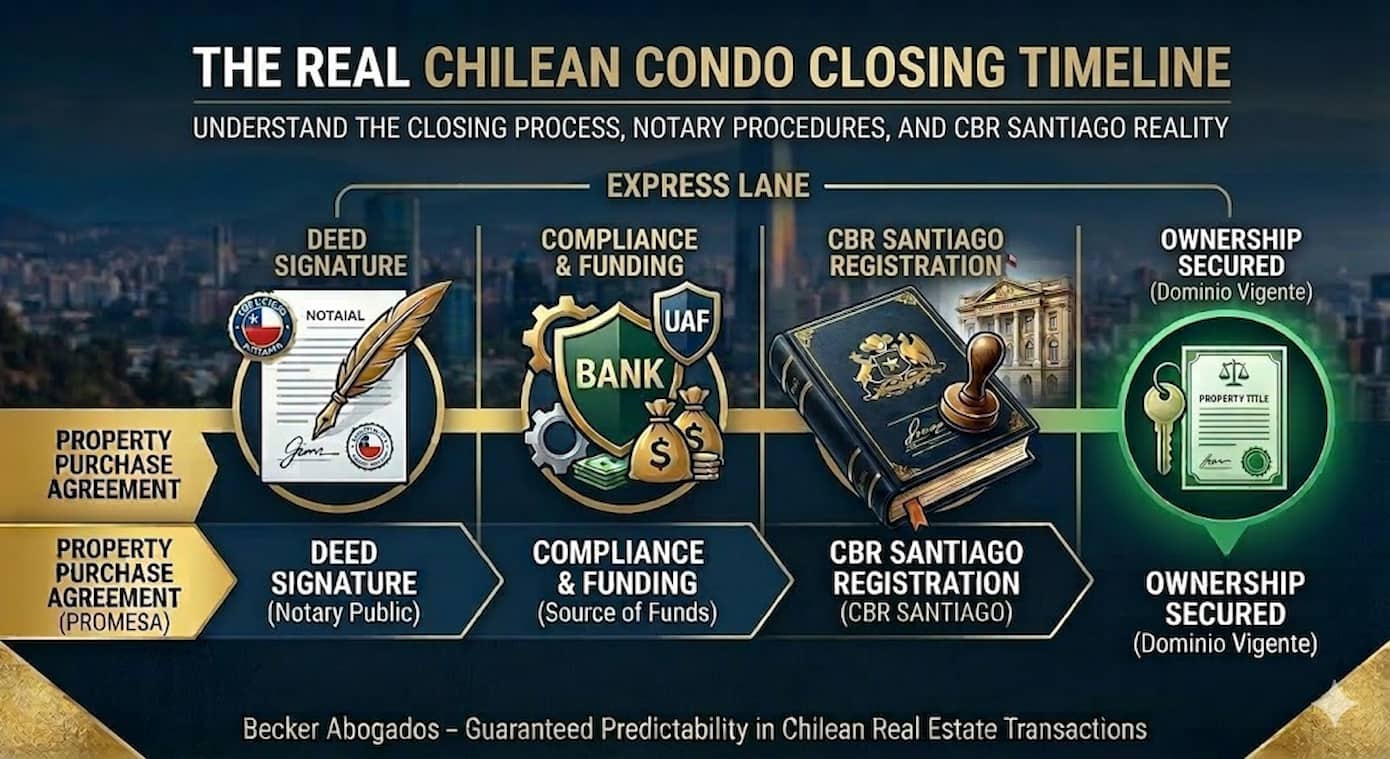
Luxury real estate transactions in Chile follow a structured legal process that is often unfamiliar to foreign investors. While the purchase agreement may be signed quickly, the actual transfer of ownership depends on several administrative stages that must take place before the deal is legally completed.
These stages—ranging from signing the deed before a real estate notary in Santiago to registering the transaction with the property registry—define the property closing timeline for buyers in Chile.
For investors purchasing high-value apartments in Santiago, understanding the CBR Santiago processing time and the sequence of legal steps involved can make the difference between a smooth acquisition and a frustrating experience.
Forget what the broker told you. Learn the real timelines for payment, delivery, and registration
Real estate brokers often focus on securing the deal quickly, which can create unrealistic expectations about how long the closing process will actually take. In practice, a condo purchase in Chile moves through fourth main phases or steps before the buyer becomes the registered owner.
Step one: preparation of the purchase deed
The first phase is the preparation of the purchase deed. Once the buyer and seller agree on the terms, lawyers draft the public deed, the official document that will transfer ownership. This document is then signed before a notary.
The real estate notary Santiago system plays a central role in this stage. Notaries verify the identities of the parties, confirm the legal validity of the document, and formalize the transaction. Depending on scheduling and document preparation, this step can take anywhere from a few days to a couple of weeks.
Step two: signing the purchase deed
Once the contract is finalized, both parties must sign the deed before a notary. If the buyer is abroad, this step may involve a power of attorney previously prepared for the transaction. After signing, the payment process is usually completed through a bank transfer or escrow structure agreed upon by the parties.
At this point, many buyers believe the transaction is finished. However, legally speaking, the most important step still remains: registering the property.
Step three: submitting the deed to the CBR (Conservador de Bienes Raíces)
After the deed is signed, it must be filed with the Conservador de Bienes Raíces (CBR). This registry office is responsible for recording property ownership and updating the official records. The CBR Santiago processing time depends on the workload of the registry office and the complexity of the transaction. In many cases, the review and registration process may take several weeks.
During this time, the registry examines the documentation to confirm that the transfer complies with legal requirements and that there are no inconsistencies in the title. Only after this review is completed will the buyer appear as the official owner in the registry.
Step fourth: final registration and ownership confirmation
Once the CBR accepts the documentation and records the transfer, the buyer officially becomes the legal owner of the property. This final step marks the true completion of the property closing timeline Chile investors must follow.
Until the registration is finalized, the seller technically remains the registered owner in the legal system. For foreign investors unfamiliar with Chile’s registry-based ownership structure, this detail often comes as a surprise.
Where transactions usually slow down
Even when both parties are ready to move forward, several practical factors can extend the closing process.
A common issue occurs when the purchase deed contains small technical inconsistencies. The registry may return the document for corrections before accepting the filing. While these adjustments are usually simple, they can add extra days or weeks to the timeline.
Another frequent cause of delay is the coordination between banks, notaries, and legal representatives. International wire transfers, compliance checks, and document verification often need to align before the transaction can proceed smoothly.
However in high-value transactions, these administrative pauses are not unusual. They are simply part of the operational reality of the Chilean system.
Timing expectations for international investors
Foreign buyers often plan travel schedules, property renovations, or rental strategies around the expected closing date. However, the CBR Santiago processing time can vary depending on the workload of the registry office and the quality of the documentation submitted.
For this reason, experienced investors rarely rely on optimistic closing estimates. Instead, they plan their purchase timeline around realistic administrative expectations.
Having clarity about the property closing timeline Chile helps investors avoid unnecessary pressure and allows them to coordinate financial transfers, property delivery, and future plans more effectively.
Managing the process without surprises: The perspective of Becker Abogados
For a foreign investor in Chile, closing on a luxury property is not immediate upon price agreement; it is a multi-stage legal process where Becker Abogados guarantees security and a smooth transaction.
- Signing the public deed: this takes place before a notary in Santiago. If the buyer is abroad, we use a duly apostilled Power of Attorney (PoA).
- Compliance management (UAF): Chilean banks apply strict controls on the origin of funds. Proactive document preparation avoids bank holds and delays.
- Registration with the property registry (CBR): the final milestone is registration with the Property Registry (Conservador de Bienes Raíces). Only after this step, which depends on the processing times of the Santiago Property Registry, is legal ownership acquired.
As a law firm specializing in high-net-worth transactions, at Becker Abogados we understand that for an international investor, time is as valuable an asset as property itself. Therefore, our approach focuses on transforming a complex administrative process into a predictable and secure critical path.
Becker Abogados eliminates uncertainty by coordinating notaries, banks, and property registrars, enabling successful remote closings without the client having to travel to Chile.
Plan your move with certainty. Get a realistic closing roadmap today.



Recent Comments