
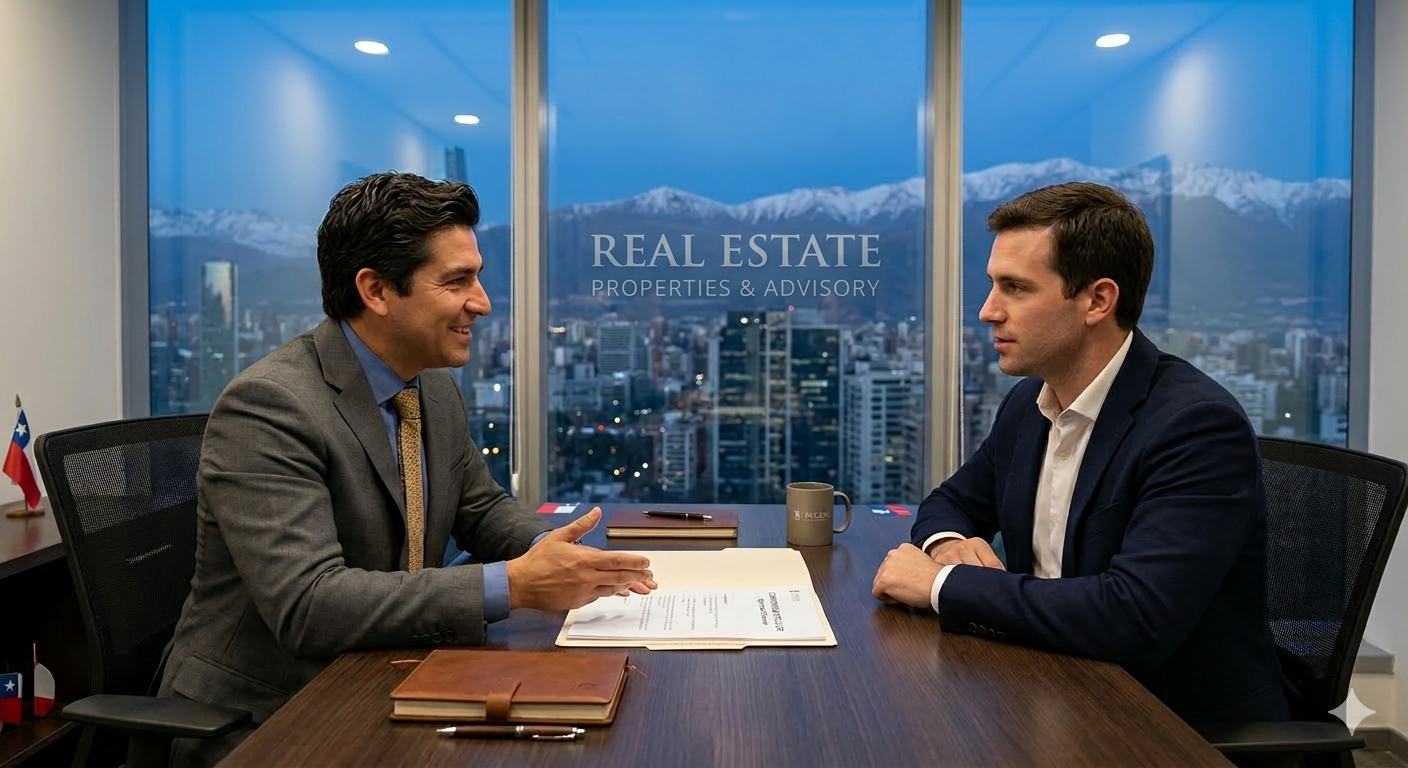
Commission structures are one of the least transparent aspects of real estate transactions for foreign investors in Chile. While the purchase price is usually clear, the broker’s fee—and when it must be paid—can vary significantly depending on the deal, the parties involved, and how the agreement is structured.
Understanding how broker fees Santiago are typically calculated, and how real estate commission Chile IVA applies, is essential to avoid overpaying or committing to unfavorable terms.
For buyers navigating the market for the first time, knowing when and how to pay real estate agent Chile commissions can make a meaningful difference in the overall cost of the investment.
Don’t overpay. Understand the standard rates and whether you should pay at the promissory or final deed
In Chile, real estate broker commissions are not fixed by law. Instead, they are negotiated between the parties and typically expressed as a percentage of the transaction value.
For residential properties, the most common structure is:
- 2% + VAT (IVA) for the buyer
- 2% + VAT (IVA) for the seller
This means that a buyer may end up paying approximately 2.38% of the purchase price, once VAT is included.
However, these percentages are not mandatory. In some transactions—especially high-value deals—commissions can be negotiated downward or structured differently depending on market conditions.
How VAT (IVA) applies to broker fees
In Chile, broker services are subject to VAT—Value Added Tax (IVA), which is currently 19%. This means that any agreed commission must include an additional 19% tax unless explicitly stated otherwise.
For example:
- A 2% commission becomes 2% + 19% VAT = 2.38% total.
Foreign investors who are not familiar with Chilean tax structures often overlook this detail, assuming that the quoted commission already includes all applicable taxes.
Failing to clarify whether real estate commission Chile IVA is included can lead to unexpected costs at closing.
Promissory vs. final deed: why timing matters
Paying the commission at the promissory stage may expose the buyer to unnecessary risk, particularly if:
- Legal issues are discovered during due diligence.
- Financing falls through.
- The transaction is delayed or cancelled.
From a risk management perspective, many investors prefer to structure the commission so that it is paid only after the final deed is signed and the transaction is completed. However, achieving this structure requires negotiation and clear contractual language.
At this stage, many buyers involve Becker Abogados to review the brokerage agreement and ensure that the payment conditions are aligned with the buyer’s interests rather than solely with the closing of the promissory contract.
When is the commission actually earned?
One of the most important—and frequently misunderstood—points is when the broker’s commission becomes payable. In Chile, this is not automatically tied to the final transfer of ownership. Instead, it depends on the agreement between the parties. In many cases, the commission is considered earned when:
- The buyer and seller sign the promissory contract (promesa de compraventa).
This means that even if the transaction does not reach the final deed stage, the broker may still claim their commission if the promissory contract was successfully executed.
For foreign investors, this can be a critical risk.
Hidden variations in commission agreements
Not all brokerage agreements are structured the same way. Some contracts may include clauses such as:
- Commission payable upon signing any binding agreement.
- Partial payments at different stages of the transaction.
- Penalties if the buyer withdraws after certain milestones.
- Exclusivity clauses limiting the buyer’s options.
These variations can significantly affect the total cost of the transaction and the level of financial exposure.
For this reason, to pay real estate agent Chile commissions properly involves more than simply accepting the standard percentage.
Why negotiation is an important part of the process
In Chile, broker fees are negotiable—especially in high-value transactions. Foreign investors often assume that commission percentages are fixed, but in practice, there is room to:
- Adjust the percentage based on the property value.
- Modify when the commission is paid.
- Condition payment on successful completion of the transaction.
Approaching this negotiation with a clear understanding of market standards can lead to more favorable terms.
Avoiding overpayment and misaligned incentives
The structure of the commission can influence the behavior of everyone involved in the transaction. If the broker’s payment is secured too early, their incentive to support the transaction through to completion may decrease.
On the other hand, aligning commission payment with the successful closing of the deal ensures that all parties remain focused on completing the transaction properly.
This is why many experienced investors choose to review commission structures carefully before signing any agreement.
A quick analysis before committing
Before agreeing to any commission terms, take a moment to evaluate how and when the payment will be triggered.
- Is the commission tied to the promissory contract, or to the final closing?
- Does the percentage include VAT?
- Are there conditions that could require payment even if the deal does not go through?
Many foreign investors work with Becker Abogados at this stage to review brokerage agreements and ensure that the commission structure is fair, transparent, and aligned with the overall transaction strategy.
A short legal review before signing can prevent unnecessary costs and protect your negotiating position.
Negotiate like a pro. Learn the rules of Chilean real estate commissions.



Recent Comments